
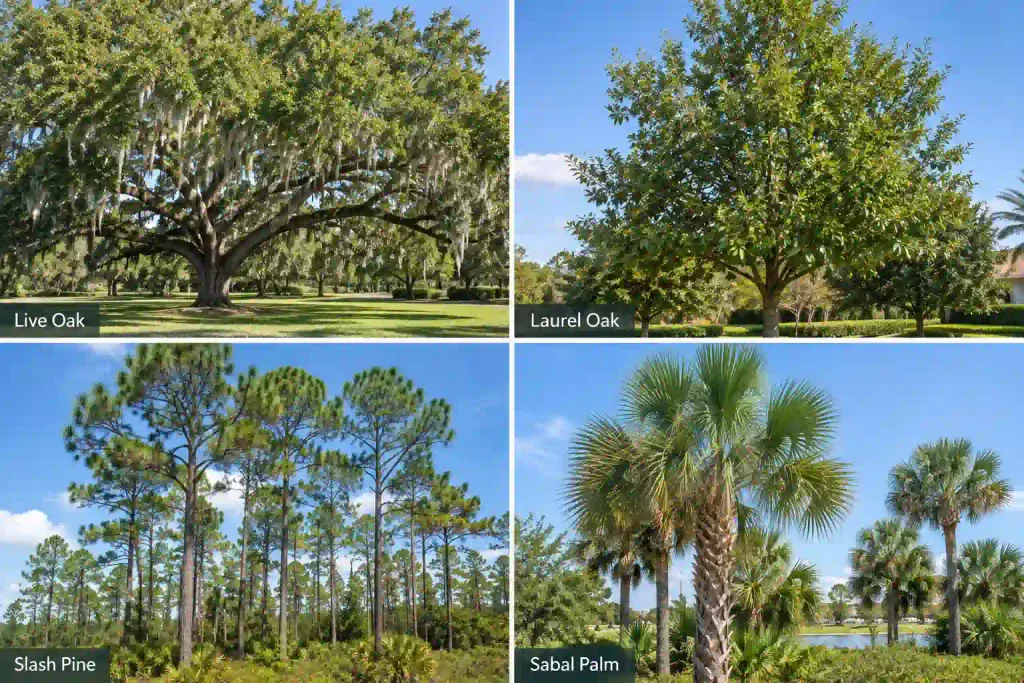
Identifying existing Tree Species is an important step in maintaining safe, healthy, and attractive landscapes in Plantation, Florida. Many established properties throughout Broward County contain mature Live Oaks, Laurel Oaks, Slash Pines, and Sabal Palms that have grown for decades. Understanding which trees are present helps property owners make informed decisions about maintenance, potential hazards, preservation, and landscape planning.
Plantation’s warm, humid climate and seasonal storms create specific challenges for mature trees. Some species develop large canopies, others have different structural characteristics, and certain trees may become more vulnerable to internal decay as they age. Correct identification gives property owners and arborists a starting point for evaluating each tree according to its characteristics and condition.
All About Trees Tree Service provides professional tree care throughout Plantation and Broward County, including tree risk assessments, arborist consultations, and tree survey and disposition services. Its ISA Certified Arborist-led team can help property owners understand their existing trees and determine appropriate next steps for responsible landscape management.
Why Identifying Tree Species Matters
Different trees have different growth patterns, maintenance requirements, and structural characteristics. Correct identification helps prevent a one-size-fits-all approach to tree care and supports more informed decisions about pruning, preservation, and risk management.
For example, a mature Live Oak may require structural pruning to maintain a balanced canopy, while an aging Laurel Oak may need closer evaluation for internal decay. A Slash Pine may develop deadwood as it matures, and a Sabal Palm may require a different approach to maintenance than a broad-canopied hardwood.
Identifying Tree Species is also useful when planning landscaping projects, documenting property vegetation, or preparing a tree survey. Knowing what grows on a property helps an arborist evaluate each tree in context rather than relying on appearance alone.
For Plantation homeowners, this information can be particularly valuable because established neighborhoods often contain mature trees whose condition and structural stability deserve periodic professional attention.
Common Tree Species Found in Plantation, Florida
Plantation’s established residential neighborhoods include several familiar South Florida tree species. Although the exact trees vary from property to property, the following are important examples that local property owners may encounter.
Live Oak
Live Oak is valued for its broad canopy, substantial branches, and long lifespan. These trees provide shade and contribute significantly to the appearance of residential landscapes.
As Live Oaks mature, their size and branch structure make proper maintenance important. An arborist may evaluate major branch attachments, deadwood, canopy balance, and the condition of the root area. Appropriate structural pruning can help maintain the tree’s form while reducing selected hazards.
Laurel Oak
Laurel Oak is common in established Plantation neighborhoods. It can grow relatively quickly, but it generally has a shorter lifespan than Live Oak and may develop internal decay that is difficult to identify through a casual visual inspection.
Property owners should pay attention to dead branches, cracks, fungal growth, and other signs of decline. These symptoms do not automatically mean a tree must be removed, but they may justify a closer assessment by a qualified arborist.
Slash Pine
Slash Pine is another species found in South Florida landscapes. It has a different growth habit from broad-canopied oaks and can develop deadwood as it matures.
Regular assessment can help identify dead branches, changes in the trunk, and concerns involving the root area. Because mature trees can be affected by storms, evaluating their condition before severe weather is a sensible part of property maintenance.
Sabal Palm
Sabal Palm is a familiar palm species throughout Florida. Its upright growth form distinguishes it from the large spreading canopies of Live Oaks and Laurel Oaks.
Palm maintenance differs from hardwood tree care. Property owners should avoid excessive frond removal and seek professional guidance when a palm displays unusual decline, damage, or structural concerns.
Identifying these species correctly helps determine which maintenance practices are appropriate for the tree in question.
How Professionals Identify Existing Tree Species
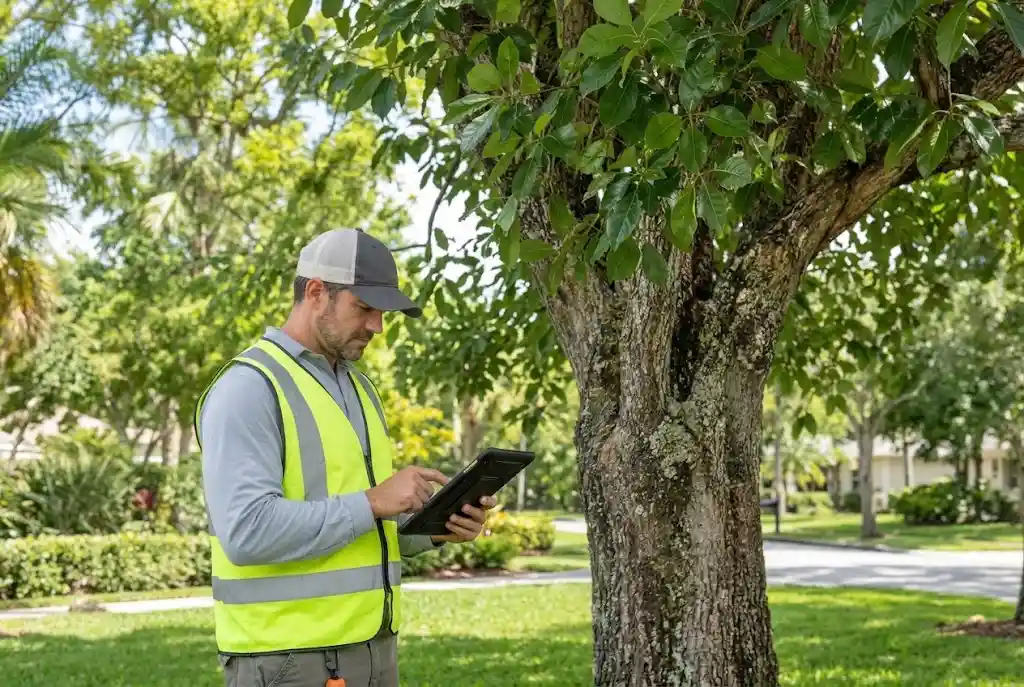
Tree identification involves more than looking at a tree’s overall shape. Several physical characteristics can help distinguish one species from another, and professional evaluation considers these features together.
Leaves and Foliage
Leaf shape, size, arrangement, and texture can provide useful clues. Some trees have broad leaves with distinctive lobes, while others have narrow, needle-like foliage or palm fronds.
However, leaves alone may not be sufficient for accurate identification. Seasonal changes, damage, and differences between young and mature trees can make visual comparisons more difficult.
Bark and Trunk Structure
Bark texture, color, patterns, and trunk shape can help narrow down possible species. Mature trees may develop distinctive bark characteristics that are not present on younger specimens.
An arborist can examine the trunk alongside other features to improve identification accuracy.
Branching and Canopy Shape
The way a tree branches and develops its canopy can also provide clues. Some species form broad, spreading crowns, while others have more upright growth patterns.
Canopy shape should be considered alongside foliage, bark, and other identifying features rather than used as the sole basis for identification.
Overall Condition and Growing Environment
The surrounding environment can help explain a tree’s development. Available space, soil conditions, nearby structures, and exposure to wind may affect its shape and growth.
These factors are also useful when evaluating whether a tree has enough room to mature and whether its location creates potential conflicts with buildings, driveways, utilities, or other landscape features.
What Is a Tree Survey and Disposition?
A tree survey and disposition service documents existing trees and helps determine how they should be addressed within a property management or development plan. Depending on the project’s requirements, the process may involve recording tree locations, identifying species, documenting relevant characteristics, and evaluating which trees should be preserved, maintained, relocated where feasible, or considered for removal.
For property owners and project planners in Plantation, a tree survey can provide a clearer understanding of existing vegetation before landscaping changes or construction begins.
A survey and disposition assessment may help answer questions such as:
- Which trees are present on the property?
- Where are the trees located in relation to proposed work?
- Which trees should receive additional evaluation?
- Are there visible health or structural concerns?
- Which trees may be suitable for preservation?
- What documentation may be needed for a project or local review?
The exact information required depends on the property’s circumstances and the applicable local requirements. A tree survey should not be assumed to satisfy every permit or development requirement automatically. Property owners should confirm the required documentation with the relevant local authority before beginning work.
All About Trees lists tree survey and disposition among its tree services. Property owners can contact the company to discuss their project’s requirements and determine what assessment or documentation may be appropriate.
How Tree Identification Supports Tree Risk Assessments
Identifying a tree is only one part of understanding its condition. Species information can help guide a broader assessment, but it does not independently establish whether a tree is safe or hazardous.
A professional tree risk assessment considers factors such as structural defects, the likelihood of failure, the possibility that a falling tree or branch could strike a person or structure, and the potential consequences.
An arborist may examine the trunk, major branch unions, root collar, and canopy for warning signs. These can include significant deadwood, cracks, fungal growth, an unusual lean, or disturbed soil around the base.
All About Trees provides formal tree risk assessments led by an ISA Certified Arborist with Tree Risk Assessment Qualification (TRAQ). Depending on the findings, recommendations may include monitoring, corrective pruning, additional diagnostic evaluation, support systems, or removal when the risk cannot be managed appropriately through less intrusive measures.
Species identification helps establish context, while the actual assessment determines the recommended course of action.
Planning Tree Maintenance in Plantation
Once existing Tree Species have been identified, property owners can create a more organized maintenance plan. The appropriate approach depends on the age, condition, location, and characteristics of each tree.
For mature Live Oaks, maintenance may focus on structural pruning and deadwood removal. Laurel Oaks may warrant particular attention when signs of decline or internal decay are suspected. Slash Pines should be evaluated for dead branches and storm-related damage, while Sabal Palms require maintenance suited to palm growth.
Plantation’s seasonal storms make advance preparation especially important. Scheduling a professional assessment before severe weather can help identify concerns that might otherwise remain unnoticed until a branch fails or a tree becomes unstable.
Tree maintenance should not rely on species alone. Two trees of the same species may have very different conditions because of soil changes, previous pruning, root disturbance, disease, or nearby construction. Individual evaluation helps ensure recommendations reflect the actual tree and its surroundings.
Professional Tree Survey and Arborist Services in Plantation, FL
All About Trees Tree Service provides tree services throughout Plantation and Broward County, including tree risk assessments, arborist consultations, tree trimming, tree pruning, tree removal, and tree survey and disposition services.
The company is led by an ISA Certified Arborist, License FL-10096A, and offers TRAQ-qualified risk assessments. Its services support homeowners and commercial property managers who need a better understanding of existing trees, potential hazards, and appropriate maintenance options.
When arranging a tree survey or identification service, property owners should explain why the information is needed. A residential maintenance plan, proposed construction project, insurance request, or local approval process may involve different documentation requirements.
All About Trees can discuss the property’s conditions and the scope of service needed. The company is located at 4933 SW 44th Avenue, Fort Lauderdale, FL 33314, and can be reached at (954) 608-8837 to request a consultation or estimate.
Make Informed Decisions About Your Property’s Trees
Identifying existing Tree Species is a practical first step toward responsible landscape management in Plantation, Florida. Recognizing trees such as Live Oak, Laurel Oak, Slash Pine, and Sabal Palm helps property owners understand their landscape and plan maintenance according to each tree’s characteristics.
When species identification is combined with professional assessment and appropriate documentation, property owners can make better-informed decisions about preservation, pruning, risk management, and future landscaping projects.
If you need help identifying trees on your Plantation property or documenting them for a planned project, contact All About Trees Tree Service to discuss its tree survey and disposition and arborist services. A professional evaluation can help clarify what is growing on your property and what steps may be appropriate for its continued care.