
Fort Lauderdale’s tropical climate helps citrus trees grow for much of the year, but the same warm temperatures, heavy rainfall, and sandy, fast-draining soil can make it difficult for trees to maintain consistent access to nutrients. Yellow leaves, weak growth, sparse foliage, and declining fruit production can sometimes indicate a nutrient problem rather than a tree that is simply “dying.” Fort Lauderdale citrus plant fertilizer Guide explains how professional fertilization can support struggling citrus trees while addressing the local soil conditions that make nutrient management especially important.
All About Trees Tree Service provides professional tree fertilization using deep-root applications designed to restore nutrients to trees. Its arborist-led approach also considers local soil conditions, with deep-root fertilization identified as a way to correct nutrient deficiencies in South Florida’s sandy soils. The company is led by an ISA Certified Arborist, Lic. FL-10096A, and has more than 15 years of experience serving Broward County.
Why citrus plant fertilizer in Fort Lauderdale matters
Citrus trees generally appreciate Florida’s warmth and sunlight, but healthy growth still depends on the root system having access to the right nutrients.
Fort Lauderdale’s sandy soil creates a particular challenge because water can move through it quickly. Heavy seasonal rainfall can further influence how long nutrients remain available around the roots.
A tree may therefore receive plenty of water while still experiencing nutritional stress.
That distinction matters.
If a citrus tree develops yellow foliage or weak new growth, simply watering it more may not solve the underlying problem. Likewise, adding fertilizer without understanding what the tree needs can be ineffective.
Professional tree fertilization provides a more targeted approach.
Sandy Soil Can Lose Nutrients Quickly
Sandy soil has relatively large spaces between soil particles, allowing water to drain rapidly.
That is useful for preventing prolonged waterlogging, but nutrients can also move away from the active root zone more quickly.
For established citrus trees, maintaining an appropriate nutrient supply can therefore be an important part of long-term care.
Signs Your Citrus Tree May Need Fertilization
A struggling citrus tree does not always need fertilizer.
Pests, disease, root damage, drainage problems, improper irrigation, and environmental stress can produce symptoms that resemble nutrient deficiencies.
However, several signs deserve professional evaluation.
Yellowing Leaves
Yellow leaves can be associated with several different problems, including nutrient deficiencies.
If the foliage is consistently pale or yellow while the tree otherwise appears stressed, a professional can evaluate the tree and surrounding soil rather than automatically applying more fertilizer.
Weak or Slow New Growth
Healthy citrus trees should produce new growth during appropriate growing periods.
If new shoots are weak, sparse, or noticeably smaller than expected, nutritional stress may be one factor.
Sparse Canopy
A tree that has gradually developed thin foliage may not be receiving everything it needs to maintain healthy canopy development.
This can be particularly concerning when combined with yellowing leaves or reduced vigor.
Declining Fruit Production
Citrus trees need adequate nutrition to support flowering, fruit development, and overall plant health.
A decline in fruit production does not automatically mean the tree needs more fertilizer, but it can be a reason to have the tree and its growing conditions professionally assessed.
A Fort Lauderdale Citrus Tree Recovery Scenario
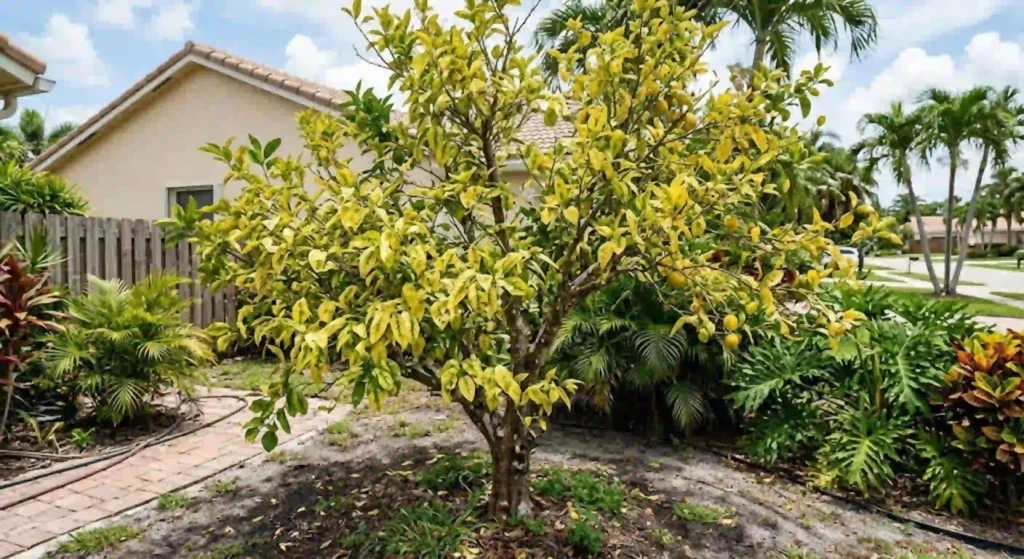
Consider a Fort Lauderdale homeowner with an established citrus tree that has gradually developed pale leaves and noticeably thinner foliage.
The tree receives regular irrigation and plenty of sunlight, so the homeowner assumes it should be healthy. They begin adding general-purpose fertilizer but see little improvement.
Instead of continuing to apply products without knowing what is wrong, the homeowner schedules a professional tree evaluation.
An arborist examines the tree, considers the soil and growing conditions, and determines whether nutrient deficiency is contributing to the decline.
If fertilization is appropriate, a professional deep-root application can deliver nutrients into the root zone rather than simply placing fertilizer on the soil surface.
The tree can then be monitored as part of a broader care program.
This is an illustrative scenario rather than a specific All About Trees customer case. It demonstrates why diagnosing the problem first is more reliable than repeatedly applying fertilizer.
Why Deep Root Fertilization Is Different
One of the key advantages of professional tree fertilization is application technique.
Simply spreading fertilizer around the base of a mature tree does not necessarily mean nutrients will reach the roots where they are needed.
All About Trees specifically provides deep-root fertilization. Its service information describes this approach as a way to restore nutrients depleted by soil conditions and long-term root competition.
Deep-root applications are particularly relevant for established trees because their active roots extend beyond the immediate area around the trunk.
The objective is to place nutrients where the root system can access them rather than relying entirely on surface application.
Fertilizer Should Match the Tree’s Needs
The goal of professional fertilization is not to give a tree as much fertilizer as possible.
Too much of a particular nutrient can create another imbalance.
A professional assessment helps determine whether fertilization is appropriate and what type of treatment makes sense for the tree’s condition.
For citrus trees showing symptoms of nutritional stress, soil analysis can also provide useful information before a treatment program is developed.
Citrus Trees and Soil Testing Work Together
Fertilization and soil testing can complement one another.
If a tree is declining, understanding the soil can help determine whether the problem is actually related to nutrient availability.
All About Trees also provides soil sampling and analysis, including evaluation of soil pH and nutrient conditions. Its South Florida service information specifically connects soil analysis with diagnosing nutrient deficiencies and conditions affecting tree health.
This matters because a nutrient can be present in the soil but still be difficult for the tree to absorb under certain soil conditions.
Testing can therefore provide useful information before a long-term fertilization program is established.
Why Fort Lauderdale Citrus Trees Need Professional Attention
Fort Lauderdale’s warm conditions encourage plant growth, but they also mean trees can face year-round environmental pressures.
Heavy rainfall can affect soil nutrients and moisture. Sandy ground can drain quickly. Heat can increase water demand. Storms and hurricanes can cause physical stress to branches and roots.
A citrus tree that is already nutritionally weak may have less capacity to cope with additional stress.
Professional tree care takes these conditions into account.
All About Trees’ Fort Lauderdale service is led by an ISA Certified Arborist, Lic. FL-10096A, and the company states that it has more than 15 years of experience serving Broward County.
That level of expertise is valuable because fertilization should be part of an overall tree-health strategy rather than an isolated treatment.
Why DIY Citrus Fertilization Can Fail
Citrus fertilizer is widely available, which can make professional fertilization seem unnecessary.
But the biggest challenge is not finding fertilizer.
It is determining whether fertilizer is actually the solution.
A homeowner may see yellow leaves and assume the tree needs more nitrogen. Another homeowner may apply a general fertilizer without considering the soil’s pH or existing nutrient levels.
Neither approach necessarily addresses the real problem.
If the tree has root damage, poor drainage, a pest infestation, disease, or another underlying condition, fertilizer alone will not restore it.
Professional assessment helps separate nutritional problems from other causes of decline.
Mature Trees Are Especially Difficult to Treat
Large citrus trees have extensive root systems.
Applying fertilizer only around the trunk does not necessarily provide adequate coverage of the active root zone.
Professional equipment and application methods allow arborists to treat established trees more strategically.
How Professional Citrus Tree Fertilization Supports Recovery
A professional fertilization program should fit the tree rather than follow a one-size-fits-all schedule.
The process can include several important steps.
1. Evaluate the Tree
The arborist looks at foliage, canopy density, new growth, overall vigor, and other visible indicators of tree health.
2. Consider the Soil
Soil conditions can influence nutrient availability and root performance. Where appropriate, soil sampling can help identify pH or nutrient issues.
3. Identify Nutritional Needs
The professional determines whether nutrient deficiency appears to be contributing to the tree’s decline.
4. Apply Fertilizer Correctly
When fertilization is appropriate, deep-root application can place nutrients closer to the active root zone.
All About Trees specifically lists deep-root fertilization as part of its tree fertilization services.
5. Monitor the Tree
Fertilization is not an instant cure.
The tree should be monitored for changes in foliage, growth, and overall condition. If symptoms persist, additional investigation may be necessary.
Fertilization Is Not a Substitute for Complete Tree Care
A struggling citrus tree may need more than nutrients.
Proper irrigation, pruning, pest management, disease diagnosis, soil management, and storm preparation can all influence long-term health.
For this reason, professional fertilization works best when it is incorporated into a broader tree-care plan.
All About Trees provides multiple tree services in Fort Lauderdale, including tree trimming, pruning, risk assessment, emergency tree care, tree installation, soil sampling, and fertilization.
This allows an arborist to look at the entire condition of the tree rather than treating one symptom in isolation.
When to Call a Fort Lauderdale Arborist
Consider scheduling a professional evaluation if your citrus tree has:
- Persistent yellowing leaves
- Sparse or thinning foliage
- Weak new growth
- Reduced vigor
- Declining fruit production
- Repeated nutrient-related symptoms
- Signs of stress despite regular watering
- Problems that continue after previous fertilization
The sooner the underlying cause is identified, the more options may be available for protecting the tree.
A tree that looks unhealthy is not necessarily beyond saving.
However, waiting until severe decline occurs can make recovery more difficult.
Frequently Asked Questions
Can fertilizer save a dying citrus tree?
Fertilization can help when nutrient deficiency is contributing to a tree’s decline, but it is not a universal treatment. Pest problems, disease, root damage, poor drainage, and other conditions must also be considered.
What fertilizer is best for citrus trees in Florida?
The appropriate fertilizer depends on the tree’s condition, soil, nutrient availability, and growing environment. Professional evaluation can help determine what the tree actually needs instead of relying on a generic fertilizer.
Why are my citrus tree’s leaves turning yellow?
Yellow leaves can result from nutrient deficiencies, but they can also be caused by irrigation problems, pests, disease, root stress, or soil conditions. A professional assessment can help determine the likely cause.
Is deep-root fertilization better for mature citrus trees?
Deep-root fertilization can be useful for established trees because it delivers nutrients into the root zone rather than relying only on surface application. All About Trees specifically provides deep-root fertilization as part of its professional tree fertilization service.
Should I test my soil before fertilizing?
Soil testing can be useful when the cause of poor tree health is unclear. It can provide information about nutrient levels and pH and help professionals determine whether fertilization or another treatment is appropriate.
When should I call an arborist for a struggling citrus tree?
Call an arborist when yellowing, sparse foliage, weak growth, declining fruit production, or other symptoms persist despite normal watering and routine care. Professional diagnosis can determine whether the tree needs fertilization or a different treatment.
Give Your Fort Lauderdale Citrus Tree a Better Chance to Recover
A struggling citrus tree is not automatically a lost tree. In Fort Lauderdale, sandy soil, heavy rainfall, heat, and year-round growing conditions can affect how efficiently trees obtain and retain nutrients.
The right response is not simply to add more fertilizer.
Professional tree care begins with determining why the tree is struggling. When nutrient deficiency is part of the problem, deep-root fertilization can help restore nutrients to the tree’s active root zone. Soil sampling and analysis can provide additional information when pH or nutrient availability is uncertain.
All About Trees Tree Service provides professional tree fertilization in Fort Lauderdale and Broward County under the guidance of an ISA Certified Arborist, Lic. FL-10096A. The company also offers soil sampling and analysis, tree care, pruning, trimming, risk assessments, and other arborist services.
If your Fort Lauderdale citrus tree is showing yellow leaves, weak growth, thinning foliage, or other signs of decline, contact All About Trees at (954) 608-8837 to schedule a professional evaluation and determine whether citrus tree fertilization is the right solution.