
Fort Lauderdale’s tropical climate creates ideal conditions for lush trees, but the same warm, humid environment can also contribute to decay, disease, and structural problems. With heavy rainfall, saturated soil, high winds, and hurricane exposure, Tree Rot can become a serious concern when decay weakens a trunk, branch, or root system. The challenge is that much of this deterioration may develop internally before obvious symptoms appear. A professional tree risk assessment from All About Trees Tree Service can identify hidden defects early, evaluate the likelihood of failure, and recommend appropriate measures to protect the tree and everything around it.
Why Tree Rot Is a Serious Concern in Fort Lauderdale
A healthy-looking tree is not necessarily a structurally sound tree.
Decay can begin inside the trunk or branches while the exterior continues to look relatively normal. By the time visible signs become obvious, the tree may already have significant internal deterioration.
Fort Lauderdale’s storm environment makes early detection especially important. The City of Fort Lauderdale advises property owners to look for root rot and trunk decay, along with broken branches and dead limbs, because diseased or damaged trees can be more vulnerable during severe weather.
When a tree is located near a home, driveway, fence, pool, vehicle, or other valuable property, the consequences of structural failure can be significant.
What Causes Tree Rot?
Tree decay can develop after injuries, disease, fungal activity, damaged roots, or prolonged environmental stress.
Some contributing conditions include:
- Damaged bark
- Broken or improperly pruned branches
- Root injuries
- Soil disturbances
- Fungal decay
- Storm damage
- Construction around the root zone
- Long-term moisture problems
All About Trees notes that aggressive fungal decay can hollow out portions of a trunk, while compromised root systems and structural defects can also create significant hazards.
Early Signs of Tree Rot to Watch For
Homeowners should not attempt to diagnose the exact cause of decay themselves, but recognizing warning signs can help determine when a professional inspection is appropriate.
Fungal Growth on the Tree
Fungal fruiting bodies, often called conks, can appear on trunks or branches when decay is present.
Their presence does not automatically tell you how much of the tree has deteriorated, but it is a reason to have the tree professionally evaluated.
Cavities and Hollow Areas
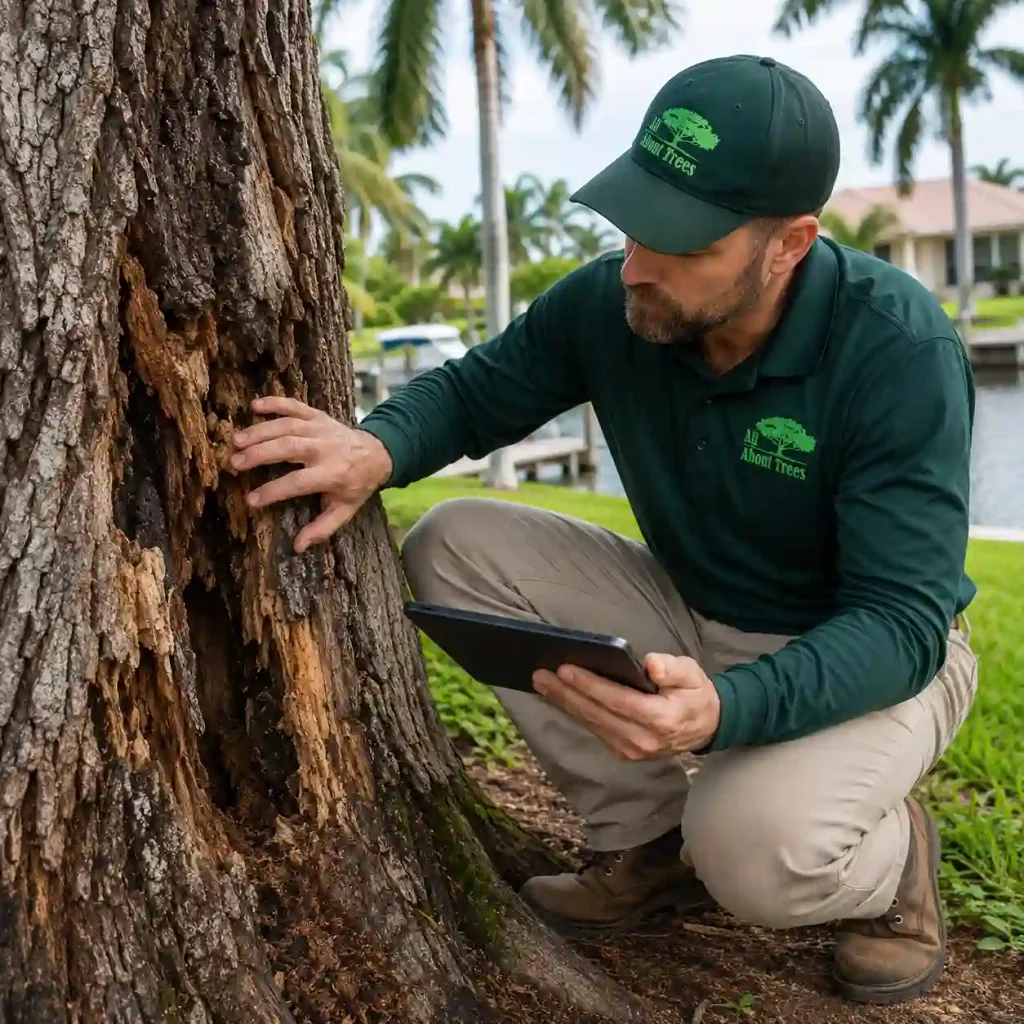
A cavity in the trunk may indicate internal deterioration.
However, the outside appearance of a cavity does not reveal the full extent of the decay. Internal damage may extend considerably beyond what is visible.
Dead or Dying Branches
Deadwood can indicate stress, disease, or structural deterioration.
Large dead branches are particularly concerning when they extend over areas where people or property are regularly present.
Excessive Lean
A newly developing or worsening lean may indicate a structural problem or compromised root system.
All About Trees includes excessive lean among the external symptoms evaluated during a professional Visual Tree Assessment.
Why Fort Lauderdale Storms Make Early Detection Important
Tree decay becomes more concerning when strong winds enter the equation.
Fort Lauderdale’s hurricane and tropical storm exposure means trees may experience powerful wind forces. The City of Fort Lauderdale specifically warns that diseased or damaged trees can blow over and that weak branches can become dangerous projectiles during storms.
A tree that appears stable during calm weather may behave very differently when subjected to extreme wind.
That is why identifying structural weakness before storm conditions arrive can be an important part of responsible property maintenance.
The Risk Is About More Than the Tree
An arborist does not evaluate a tree in isolation.
The location of the tree matters.
A decayed branch over an empty section of yard presents a different risk from the same branch extending over a bedroom, sidewalk, driveway, or pool.
Professional tree risk assessment considers what could be affected if a tree or tree part fails. All About Trees evaluates the potential target, the likelihood of failure and impact, and the severity of the consequences when determining an overall risk rating.
A Fort Lauderdale Homeowner’s Tree Rot Problem
Consider a Fort Lauderdale homeowner with a mature shade tree growing close to the house.
From the ground, the tree appears healthy. The canopy is full, and there are no obvious signs that the trunk is unstable.
After several periods of heavy rain, however, the homeowner notices fungal growth near the lower trunk and a few dead branches higher in the canopy.
Rather than waiting for the next major storm, the homeowner schedules a professional tree risk assessment.
The arborist begins with a Visual Tree Assessment, examining the tree from the root collar through the canopy. The inspection identifies the fungal growth, deadwood, and other structural indicators that require closer attention.
Because the visible symptoms suggest possible internal deterioration, the arborist recommends advanced diagnostic testing.
The assessment reveals internal decay that is more extensive than the homeowner could see from the ground.
Instead of immediately removing the entire tree, the arborist develops a mitigation strategy based on the tree’s condition and the potential targets around it. Depending on the findings, professional recommendations may include corrective pruning, supportive cabling, continued monitoring, or removal if the tree presents an unacceptable risk.
This illustrates why professional assessment matters: the goal is not automatically to remove a tree, but to determine its actual condition and identify the safest appropriate solution. All About Trees describes this same assessment philosophy, emphasizing early detection and customized mitigation rather than unnecessary removal.
Why Professional Tree Risk Assessment Is Necessary
Tree decay is not always visible from the ground.
That makes professional assessment particularly important when symptoms suggest internal structural problems.
Visual Inspection Is Only the First Step
All About Trees begins its assessment with a Visual Tree Assessment, examining the tree from the root collar to the highest portion of the canopy.
Arborists look for indicators including:
- Cracks
- Deadwood
- Fungal conks
- Excessive lean
- Structural defects
- Signs of stress
- Root-related concerns
These observations help determine whether additional diagnostic testing is appropriate.
Advanced Technology Can Reveal Hidden Decay
When visual indicators suggest internal damage, All About Trees may use non-invasive diagnostic technologies such as Sonic Tomography or Resistographs.
These tools can provide information about wood density and internal integrity, helping arborists understand the extent of decay or hollowing without relying solely on what can be seen externally.
This is a major reason Tree Rot should not be treated as a DIY inspection project.
A homeowner may recognize a cavity or fungal growth, but determining whether the tree is structurally compromised requires arboricultural knowledge and appropriate diagnostic methods.
How Tree Risk Assessments Determine the Level of Danger
Finding decay is only one part of the evaluation.
The next question is: How dangerous is it?
All About Trees uses a risk framework that considers three key factors:
Likelihood of Failure
How likely is the tree or affected tree part to fail within a specific period?
Likelihood of Impact
If it fails, how likely is it to hit something important?
Severity of Consequences
What could happen if the tree or branch strikes that target?
This means a decayed branch above a rarely used shed may have a different risk rating from an equally decayed branch above a bedroom or frequently used walkway.
The resulting risk rating can help homeowners prioritize the most important corrective measures.
Possible Solutions After Tree Rot Is Found
Discovering decay does not automatically mean that the entire tree needs to be removed.
The appropriate solution depends on the extent and location of the defect, the tree’s overall condition, and the potential consequences of failure.
Corrective Pruning
If structurally unsound or damaged branches are the primary concern, professional pruning may reduce risk while improving the tree’s structure.
Cabling and Bracing
Some trees with structural weaknesses may benefit from supportive cabling or bracing.
All About Trees lists high-strength cabling and bracing among its potential mitigation strategies when appropriate.
Monitoring
Trees with manageable defects may sometimes be monitored through future professional assessments.
Regular evaluation can help determine whether the condition is stable or progressing.
Professional Tree Removal
If decay has created an unacceptable or imminent hazard, removal may ultimately be the safest option.
A professional assessment helps ensure removal is recommended because the tree’s condition and risk justify it, not simply because a visible defect exists.
Why DIY Tree Inspection and Removal Can Be Dangerous
Tree work is not simply a matter of cutting away damaged wood.
Large trees can involve significant weight, unpredictable branch movement, climbing hazards, and proximity to structures or utility lines.
The City of Fort Lauderdale specifically advises property owners not to attempt trimming trees that touch power lines and recommends using appropriately qualified professionals for hazardous storm-damaged trees.
Professional arborists understand tree structure and can determine how decay affects stability.
All About Trees is led by an ISA Certified Arborist and holds ISA Tree Risk Assessment Qualification (TRAQ), which supports formal tree risk assessments.
How Regular Assessments Help Prevent Expensive Damage
Waiting until a branch falls or a tree fails during a storm can result in much greater costs.
A fallen tree may damage:
- Roofs
- Vehicles
- Fences
- Driveways
- Pool areas
- Electrical infrastructure
- Landscaping
- Outdoor structures
Early assessment gives property owners an opportunity to address developing hazards before they become emergencies.
All About Trees describes early hazard detection as a proactive strategy that can allow for less intrusive and potentially less expensive mitigation measures, such as pruning or supportive cabling, before a major failure occurs.
Why Fort Lauderdale Homeowners Choose All About Trees
All About Trees Tree Service provides professional tree care throughout Fort Lauderdale and Broward County. The company is led by an ISA Certified Arborist with more than 15 years of experience and holds TRAQ certification for formal tree risk assessments.
Its tree risk assessment process goes beyond a basic visual inspection. The team evaluates the tree’s structure, identifies potential targets, determines risk, and provides a detailed report with photographs and prioritized mitigation recommendations.
The company also provides tree trimming, tree removal, emergency tree service, stump grinding, arborist services, and other professional tree care.
For Fort Lauderdale property owners concerned about Tree Rot, that combination of certified expertise and risk-based evaluation can help provide a clearer understanding of what needs to happen next.
Frequently Asked Questions
Can a tree have serious rot without looking unhealthy?
Yes. Decay can develop internally, meaning significant structural deterioration may not be obvious from the exterior. Professional assessment can help identify hidden problems.
Does Tree Rot always mean a tree must be removed?
No. Depending on the severity and location of the decay, mitigation may include corrective pruning, cabling, bracing, or continued monitoring. Removal may be recommended when the tree presents an unacceptable risk.
How does a professional detect internal tree decay?
After a visual assessment, an arborist may use advanced diagnostic tools such as Sonic Tomography or Resistographs when internal damage is suspected.
Why is Tree Rot especially concerning before hurricane season?
Decay can weaken branches, trunks, or roots, potentially increasing the consequences of failure during high winds. Fort Lauderdale officials recommend checking trees for root rot and trunk decay as part of storm preparation.
How often should my trees be assessed?
The appropriate frequency depends on tree condition, age, location, surrounding targets, and other risk factors. A certified arborist can recommend an assessment schedule based on your property’s specific circumstances.
Protect Your Fort Lauderdale Property From Hidden Tree Rot
Tree Rot can remain hidden until a branch breaks, a trunk fails, or a weakened tree becomes dangerous during a storm. In Fort Lauderdale, where tropical weather and hurricane exposure place additional stress on trees, early detection can make an important difference.
A professional tree risk assessment provides far more information than a quick look at the trunk or canopy. All About Trees uses visual assessment, target analysis, risk evaluation, and advanced diagnostic technology when appropriate to identify structural problems and develop customized mitigation strategies.
If you have noticed fungal growth, cavities, deadwood, excessive leaning, or other concerning changes in a Fort Lauderdale tree, contact All About Trees Tree Service for a professional evaluation. Call (954) 608-8837 to schedule a free estimate and have an ISA Certified Arborist assess the condition and risk of your trees.